Wednesday, 28 May 2014

Clothes Cloth and Culture Group first meeting

Thursday 29th May is the first meeting of new Clothes Cloth and Culture Group at the Stuart Hall Library. The event was fully-booked within the first couple of days, so there is obviously a great deal of interest in this area of research and art practice.

The Group is a monthly forum for creative practitioners and thinkers working with cloth. Each month two presenters will talk about their research. There will be an opportunity for informal questions and  discussion at the end of the evening.  Setting cloth into the wider contexts of material and visual culture, the Group will provide a space for conversations about the politics of cloth from a distinctively cross-cultural viewpoint. 

The theme for our first meeting is 'Cloth & The Archive'; presenters will be Dr. Bharti Parmar and Dr. Wessie Ling. Read more about their ideas and research on the Library webpage.

The meetings will be convened by Dr. Christine Checinska, who is a Post-Doctoral Research Fellow at the University of East London.


Tuesday, 27 May 2014

Stuart Hall Research Network audio recording Sharlene Khan, Gitanjali Pyndiah

Sharlene Khan, Nervous Conditions
The Library's last research network meeting on 15th May proved to be a stimulating evening. 
Presentations were made by South African visual artist Sharlene Khan and cultural studies researcher Gitanjali Pyndiah. Audio recordings are now available if you missed the event.
audio recording of Sharlene Khan's presentation on SoundCloud
(Gitanjali's recording removed for editing - it will be published shortly) 

Friday, 2 May 2014

Stuart Hall Library Research Network Meeting, Thursday 15 May, 18.30-20.00

Save the Date!

Join us at our next meeting on Thursday 15 May 2014 18:30 - 20:00.


The presentations by South African visual artist Sharlene Khan, and cultural studies researcher Gitanjali Pyndiah, will be followed by an informal discussion.

More information about the presentations on the Library webpage. 

Please book via Eventbrite


I Make Art, 2013 Sharlene Khan

Monnoir, c.2007, Nirmal Hurry

Tuesday, 8 April 2014

Stuart Hall Library Research Network - call for proposals


Research Network meeting © Christa Holka


The Stuart Hall Library Research Network is a forum for researchers, artists and curators to introduce an aspect of their work. It is a meeting place for the discussion of practice-based or more conventional forms of research that may include: curatorial practice; visual arts; film and media; cultural studies; cultural activism; postcolonial studies; literary studies, including criticism and theory.

We are looking for exciting and engaging ways of uncovering your research. This might include individual presentations, presentations in pairs, in onversation/dialogue, or presenting a group project.

If you are interested in presenting at a future Research Network session, send a 200 word proposal outlining your topic to:
library@iniva.org

Next meetings: Thursday 15 May, 12 June 2014, 6.30-8.00
1 Rivington Place

London EC2A 3BA

Tuesday, 11 March 2014

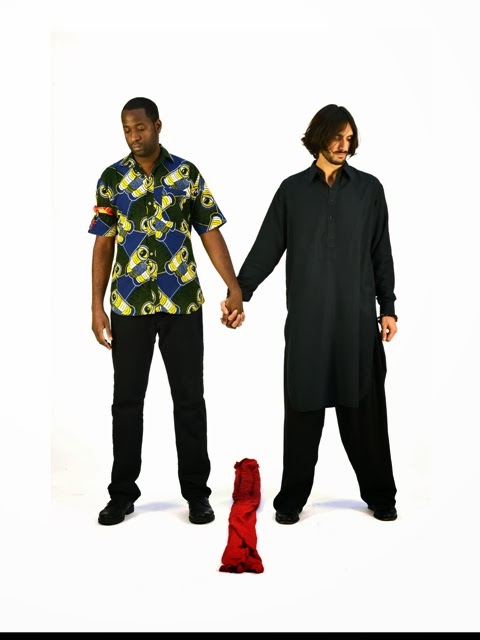
Stuart Hall Library Research Network Guest blog post: Sayed Hasan and Karl Ohiri

© Karl Ohiri and Sayed Hasan: Side by Side


My Granddad's Car  is an art project, but most importantly a personal endeavour. Our story has moved through Nigeria, Pakistan and England, affecting our families, friends and become part of our history.

I thought about bringing my granddad's car to the UK for many years and decided the best time to do so would be when it retired from its long service in Pakistan. I wanted it to make a journey across the geographic and cultural divide that separated my life from the cars and desired to physically touch it in England.

When mentioning the idea to Karl - while sitting in a pub in New Cross - we chanced upon a coincidence which kick-started our collaboration. Karl had been contemplating his grandfather's car too, after discovering it laying in ruin in his family village in Nigeria. We thought it poignant to combine our narratives and grew excited at the prospect of bringing our granddads’ cars together. This marked the beginning of the project.

After securing funding for our venture and organising the necessary steps to export the cars, Karl and I made our journeys. We understood that the experience would be challenging, but didn't anticipate the events that transpired during our trips. In the short time we spent in Nigeria and Pakistan to oversee the shipment of the cars’, the course of the project radically changed. Both cars’ - a fragile Beetle shell and a beaten-up Toyota Corolla - were unable to leave their respective countries. Karl was tricked by a corrupt port official who decided to hold his car for ransom after it entered the shipping yard in Port Harcourt (where it remains to this day). As for my car, it became lost in a legal fiasco. The car remains the possession of my late grandfather and is unable to leave the country.

After our travels we were left deflated and uncertain about the direction of the project. Eventually however, we come to accept our failure as part of the creative process and a reflection of the unpredictability of everyday life. 

It was a privilege to present a collection of our photography and video work at the Research Network in The Stuart Hall Library in December 2013. We especially took enjoyment from the discussion our project provoked. My Granddad's Car is an on-going project, so gaining the perspectives of a critically engaged group helped us to think about our own project differently.

Many thanks to Sonia Hope and Roshini Kempadoo for their support.
For more information about the Stuart Hall Library Research Network and how to participate, email the Library.


Tuesday, 11 February 2014


Save the date: Stuart Hall Library Research Network 20 February 2014

Join us at our next meeting Thursday 20th February 18:30. The presentations will be followed followed by a question and answer session.
     
Still from the video Postcard Choreographies 2013, Dan Munn
Please book your place online The event is free but we would be grateful if you could let us know if you book and then cannot attend.
Laura Preston, art critic and curator will present Next Spring
A reading from "Next Spring," a story that departs from living in a government housing project in the North East of Japan in early 2012, post-tsunami and nuclear disaster. Tracing recent time-based-film and photographic-works made by artists in Japan and connected to the energy politics of this island state, the text considers the possibilities of imaging an invisible threat.
Laura Preston is currently on residency at the Cité internationale des arts, Paris. Her practice as an art critic questions understandings of time and the production of space. As a curator she endeavours to present different models for publishing. She has worked at May contemporary art journal, Paris, 2013; Portikus, Frankfurt am Main, 2012; Adam Art Gallery, Victoria University of Wellington, 2008-2012; Witte de With, Rotterdam, 2007; and Artspace, Auckland, 2006. She continues to work for the Adam Art Gallery as Curator-at-Large.
Dan Munn, artist and writer  will present
Where in time is Europe's last wilderness?
Just over a year ago I took a trip to the town of the indigenous capital of Karasjok in Norway's Far North. I was curious as to how climate defines natural and cultural geography, specifically in regard to producing difference for the tourist market. Through recollections from this trip and a screening of Postcard Choreographies, 2013, which I produced on my return, I ask a series of questions including:
How has distance been replaced as the main signifier of remoteness?
Why did my bottle of Corona cost so much?
What kind of time do Far North cultural activities produce and what is it about traditional technologies that affects our experience of time?
Ski vs. phone: what does it mean to get nowhere?
Dan Munn is an artist and writer based in London. He recently completed an MA in Fine Arts at Goldsmiths College and has contributed to Art New Zealand, thisistomorrow, C Magazine, and Eyecontact, with work forthcoming in Magazine Issue 3 and The Pantograph Punch.

More information

Please book your place online (see above)
Enquiries library@iniva.org 020 7749 1255

Monday, 20 January 2014

Save the date - Stuart Hall Library Research Network meeting, Thursday 30 January 2014, 6.30-8.00


Thursday January 30th : our first Research Network meeting of 2014.

Performance poet, life model, writer and photographer Ursula Troche will present 


Ursula Troche performing at the Notting
Hill Arts Festival, August 2013
Dialogues on Otherness in Research and practice
 'In my own (performance poetry based) research, I am ‘dealing with myself’ as an othered person of a kind that still needs explanation – hence another kind of otherness. In my case, this means explaining what it means to be ‘neither Black nor British’, why this is relevant, and how this is part of the postcolonial debate even if I do not originate from a colonised country. I do not therefore speak from the margins or the centre (e.g. hooks 1984), even though this framework is important for my location; I speak from the ‘boundary’ – as yet another kind of ‘Other’. This also leads me to an investigation of the psychological aspect of this debate, which shares with postcolonial studies an analysis of ‘otherness’, if from a different angle (i.e. Lacan). This then, is another investigation of and on otherness, which build on Stuart Hall’s investigations of around this theme, specifically his notion of ‘new ethnicities’. Lastly, I want to come back to the question of dialogue: how can (this) research contribute to open up the wider need to continue to break silences around ‘otherness’ and ‘race’ and critiques of dominant discourses.'

Also, artist, teacher and writer Jenny Jones will present 


Gatekeepers (2012)  © Jenny Jones
Re-imagining Old Chestnuts
'In this talk I present questions arising from paintings I made as part of the group show "Lodgistics" made in response to College Lodge in Dulwich Park, South London. The renovated Lodge, now a 'multicultural' arts centre run by the charity Whippersnappers, stands opposite the Dulwich Picture Gallery, the oldest public art gallery in Britain. The paintings depict 'Black' cherubs together with conkers, the seeds of the horse chestnut tree.
My artwork has always arisen from lived experience and the perceived 'trouble' with this research is threefold. Firstly: is there or isn't there a sense of taboo in a 'White' (working class) woman picturing 'Black' figures, from her own imagination? (eg: the perception of appropriating 'Black' art?). Secondly, the histories I researched in the making of the work: Kemet, the Bible, the Formorians and Rudolf Steiner's writings are all marginalised knowledge, discounted as mythological, unscientific or transcendent. Thirdly, the models for 'White' picturing 'Black' in visual representation have often been heavily criticised. One example being how Parisian avant garde artists' 'Negrophilia' in the 1920's was seen to be associating 'Black' people with the 'primitive'. I will be using this painting to open up discussions around 'transgressive texts' (Toni Morrison), aesthetics and self-racialization. Finally I want to raise the question: How do 'White' artists work to indicate their allegiance with anti-racism and critique 'White' privilege without being 'happy' or 'proud' (Sarah Ahmed).'

Listen to a recording of the event via the link below

Thursday, 19 December 2013

The Second Stuart Hall Library Animateur for Iniva: Call for Proposals


© Christa Holka

1 February 2014 – 31 December 2014

Voluntary position, with expenses paid

Following the success of Iniva’s first Animateur Roshini Kempadoo (2013), Iniva’s Stuart Hall Library is seeking proposals for the second Animateur to work with the Library over a period of up to ten months during 2014.


Aims
The role is intended to establish an exchange of knowledge between the artist, curator or researcher, Iniva and its Library staff. The Stuart Hall Library Animateur will have the opportunity to:


  • Explore the Library’s printed, archive and audio-visual material for the artist/researchers/curator’s creative and scholarly publishing/exhibition ambitions.
  • Generate intellectual and creative activity in collaboration with Library staff.
  • Further develop networks of existing and potential Library users.
  • Assist in identifying how the Library’s collections and archive can be made more widely available


This voluntary role would suit a researcher/artist/curator whose current work resonates with that of Iniva and the Stuart Hall Library. We are looking for someone who has:


  • Experience of using archives and special collections libraries for research and artistic purposes.
  • Interest in collaborating with Library staff to promote the Stuart Hall Library and its collections, including contributing towards talks and events.
  • Knowledge of Iniva’s history, its activities, the Stuart Hall Library and its collections.


We recommend that the Animateur commits their time to the Library for the equivalent of one day per week to undertake their research and liaise with Library staff, contributing towards projects and events.
 
Please submit a CV and a proposal of 500 words to Sonia Hope (Library Manager) and Roshini Kempadoo (Photographer, Media artist and Lecturer) detailing the ways in which your role as the second Stuart Hall Library Animateur would:


  • Expand an artistic/scholarly research project you are developing.
  • Strengthen existing, and establish new networks between the Library, its users and other institutions, locally and internationally.
  • Promote the Library collections through talks, events and other communication channels. 


‘My work here in the last year has not only been a pleasurable experience but also an inspirational one. Working from the Stuart Hall Library facilitated a crucial creative thinking space to work through my own ideas whilst developing a better international perspective on visual art and culture. As an artist, sources of inspiration for my own projects were artists’ and art critics’ material – such as the recent exhibition catalogue Caribbean Art at the Crossroads of the World (2012), or Zineb Sedira’s artwork Silent Sight (2000) found in the Iniva audio-visual archive. As a scholar working on current chapters and articles for publication, conceiving and helping to develop the Stuart Hall Library Research Network and symposium as an inter-generational place for discussion of artists and critics work – has been invaluable to generate and listen to current conversation and thinking about the visual arts. 
Being based in the Library through the year is not only a quiet, comfortable and supportive alternative to a studio or office, it is more crucially, a knowledge base and specialised resource about the question of international visual art that engages critically with its circulation, production and cultural agency. The role of the Animateur is one I would recommend to anyone who is interested in international arts based research whether critic, scholar or artist.’
Roshini Kempadoo (December 2013) – 1st Stuart Hall Library Animateur for Iniva

For further information see the Iniva website and the Stuart Hall Library Blog.

Deadline for proposals: Friday 31 January 2014
Please send to Library@iniva.org 

Tuesday, 17 December 2013

Guest blog post: Jenny Jones, Stuart Hall Library volunteer

Jenny Jones, Stuart Hall Library volunteer

On just being in the library

I have been a volunteer at the Stuart Hall Library since first volunteering during Library Closed week in August 2013. After visiting the powerful Kimathi Donkor exhibition Queens of the Undead, I attended the Reading Group, several Research Network meetings and the Stuart Hall Library Symposium.  

The Stuart Hall Library supports exhibitions at Iniva by providing a display of reading matter and a bibliography related in theme to the current artists on show. The space designed by David Adjaye, features an installation by Ansuman Biswas that is sensitive to the movements of its inhabitants and I always find it unfailingly exhilarating and expansive here. Walking through the door makes me feel in touch with international artists all over the world and those from the past. No matter what my duties are that day, whether the satisfaction of shelf tidying, listing archive contents or merely perusing books, journals and zines I come across, the propensity for synchronicity and inspirational connections is extremely stimulating.

To say that the library gives an opportunity to study the histories and geographies of art that my BA in Fine Art did not cover is a huge understatement. My intention is to use the library to expand upon and question my existing knowledge of the myriad ways art is inflected and shaped by notions of race, ethnicity and culture. This encyclopaedic collection and gentle, inviting space nurtured by Library Manager Sonia Hope, is a much needed sanctuary for such an inquiry. 

I have recently enjoyed helping to list some of the backlog of archive material the library holds. This included fascinating documentation of the arts organisation OVA: Organisation of Visual Arts. This organisation based in South London during the 1980s, 1990s and 2000s, supported artists working on the margins of the mainstream Western Art during the development of ideas of the “Global Turn”. This term describes a wider recognition and acceptance of “multiple modernities” and the fact that art and culture had been negotiated locally in every culture whilst the West’s gaze had been turned inwards at itself.

A useful book for understanding these ideas is The Global Contemporary and the Rise of New Art Worlds, edited by Hans Belting, Andrea Buddensieg and Peter Weibel (library shelf no. 430.127 GLO).  This enabled me to piece together the various fragments of what I knew from my education in fine art, feminism and cultural studies about Modernism and the Other. I discovered just how overridingly the West had produced an interlocking system of capitalism, colonialism, slavery and racism that created 500 years of hegemony. The revelation that “Modern Art” as the sign of creative destruction and innovation was its cultural expression and therefore insidiously and inextricably tied in with something as seemingly disconnected as racism was an eye-opening connection. The fact that domestic, everyday and institutional racism is an ideological justification for this system’s strategic inequality and drive to politically control and engineer the world’s agricultural, mineral and labour assets, is mindblowing.

It was a privilege to get an insight into the day to day running of OVA through its correspondence between artists, curators and staff at various galleries in Britain, Canada and Japan.  There were artists CVs, slides, artists flyers and catalogues, also copious evidence of grant applications. I gleaned a picture of how publications and large scale, influential exhibitions came into being; shaping our cultural and historical field. In this sense, the functioning of OVA can be seen as an incredibly important project illustrating ideas of the “postethnic” whereby art is seen as drawing on the formal language and intellectual tradition of its country of origin, whilst being simultaneously embedded in international discourses. The careful contextualising processes unstintingly carried out by OVA’s curators Sunil Gupta and Edward Ward took the form of “rewriting” and questioning  the West’s dominance over the world.

One of the aspects I found interesting in the OVA files was the process whereby OVA’s production became digitised.  A number of individuals, including those responsible for setting up Iniva, formed a consortium and there was an efflorescence of correspondence around names for this group such as “Gather” and “Pomegranate”. Each drew up a list of artists and curators they felt should be preserved in the forthcoming digital archive. All the necessary operations of power in historicising, or in this case rewriting, are there tucked away in a small grey filing cabinet.

The OVA collection. The collection is not yet available to the public.


Jenny gained a BA in Fine Art-Painting at West Surrey College of Art and Design, a Postgraduate Diploma in Art Therapy and an MA in Feminist History, Theory and Criticism of Art at Leeds University. Her career has involved teaching art at Lambeth, Wandsworth and Southwark Adult Education, facilitating multi-media arts workshops with people with Learning Disabilities at Action Space, and lecturing in Cultural Studies for Art and Design at Croydon College, Northbrook College, the American Intercontinental University and the London College of Fashion. She was a contributing writer and co-editor of Art Therapy, Race and Culture published by Jessica Kingsley and has written for Artist and Illustrator, Make, Fold, Convergence and n.paradoxa.

Recent exhibitions have included "A New (Age) Spirit in Painting" for the ASC windowspace and also the Dulwich Artists Open Houses. She has also curated "Lodgistics" for College Lodge, SE21 and a two day event "AEthereal" at Franklin's, SE22 for Yuki Miyake's Open Draw gallery. 

Friday, 29 November 2013

Stuart Hall Library Research Network meeting, 12 December 2013, 6.30-8.00


Join us for our last Research Network meeting of the year.


Sayed Sattar Hasan and Karl Ohiri will present


My Grandad's Car

Sayed Sattar Hasan and Karl Ohiri shared a desire, they wanted to touch their grandfathers' cars in their country of birth and park them side-by-side. After much planning the artists made their respective journeys to Pakistan and Nigeria, only for their ambition of returning to the UK with the cars to end in failure. Instead, Ohiri's fragile Beetle shell and Hasan's retired hulk became stuck within dysfunctional legal systems and the uncompromising grip of corrupt officials.

My Grandad’s Car is the story of two friends who set out to explore their heritage and identities through their connections with their cars and each other. Ohiri and Hasan's project considers the legacies of migration and the relationship subsequent generations have with other home spaces. The artists unorthodox use of ritual and cultural motifs alludes to the sense of 'familiarity' and 'naivety' they feel towards everyday life in Pakistan and Nigeria, in particular as young British-born men. Through collaboration they look to develop work which disrupts conventional ethnic labels, by representing themselves as culturally hybrid and complex individuals.

The artists will be showing a selection of photography and video documenting their experiences, revealing the intimate acts and processes involved in their on-going work.

Sayed Sattar Hasan - Biography

Sayed Sattar Hasan values art as a way of contemplating and rethinking the social, political and cultural spheres that affect personal and public lives. He is influenced by his Pakistani and English heritage and plays with his hybrid identity to question norms which organise everyday life.

Themes in his work include the family, religion, the body and public interaction, explored through photography, video and installation.

Since graduating in 2009 in MA Photography and Urban Cultures at Goldsmiths, he has received funding from Arts Council England for solo and collaborative projects as well as exhibiting in galleries and art festivals nationally and internationally. Including The New Art Exchange, Heathrow Terminal 5, The primera photography biennale, Lima 2012 and LagosPhoto13.

www.sayedsattarhasan.com


Karl Ohiri - Biography

The framework of his practice consists of two overlapping points of interest; ‘cultural studies’ and 'the human condition’. This is explored through personal and public encounters primarily using photography, video and performance.

Since completing his Masters at Goldsmiths University in 2008, his artwork has been a mixture of conceptually driven, documentary based works that consist of natural and constructed images and the recontextualisation of pre-existing artefacts.

His work has been exhibited internationally (most recently at LagosPhoto13) and in various galleries throughout the UK including; The New Art Exchange, Heathrow Terminal 5 and Tate Britain.

www.karlohiri.com


Spaces in the Library are limited. Book a place here